A reflective note on Stephen Mumford’s “A Philosopher Looks at Sport”

As I’ve been asking myself (1) how I, as a father, want to teach my child about thoughtfulness and (2) how I, as a teacher, want to educate my students, I’ve been coming around to the idea that one way to engage younger mind with subjects that we think they should study is to package that subject in an accessible manner. By this, I mean teach them (A) a subject with which they’re less familiar through (B) a subject with which they have greater, and maybe more natural, familiarity. As I mentioned in a recent post (see “Sports and non-dualistic education”), as I reflect upon the adolescent version of myself—who was a mediocre student, at best—I recognize that one of the best ways to have engaged me would have been by connecting what we were learning to sports. I was obsessed with sports but not Algebra, or U.S. history. Yet it was sports that led me to be learn about Jesse Owens embarrassing Hitler, or where Baltimore is on a map, or how to calculate a batting average. For this reason, as I think about the need to teach my students the skills that will help them evaluate the wave upon wave of information that comes their way—how to be critical, skeptical even, before embracing something just because Google found it or because someone said it on TikTok—a conclusion that I’m tentatively reaching is that, for example, if I were to teach a philosophy class at my school in the future, a philosophy of sport would be the way to go. It would start with (B) sport, which matters to a majority of high schoolers, and then guide them to (A) the skills that philosophy can provide them.

As I’ve been reading on the philosophy of sport, one book that I finished recently is Stephen Mumford‘s A Philosopher Looks at Sport. It’s a small book (at 5 x 0.5 x 7.5 inches) and a short one (at about 133 pp. of content) but it’s very good. It built around six topics: physicality, competition, definition (of sport), spectacle, ethics, and inclusion. One of this main points is that we find joy in developing an ability and in displaying that ability. Sport is a venue for that development/display but it adds competition. Competition can be a negative thing but Mumford sees athletic competition as a sort of bubble where we can put forth a certain level of effort without the negative effects because ultimately, the goals are themselves “unimportant”. For example, if I were wrestling for a high school state title, it would matter to me, it would be important, but not in the same way as if I were wrestling a potential mugger or a wild animal that I encountered on a walk. The latter has my very life and well-being at stake in a way that sport doesn’t…or shouldn’t.

Once Mumford provides a working definition of sport, he addresses why we enjoy the spectacle of it all (which is very relevant right now as the Summer Olympics are in full swing) and he asks questions about the ethics of sport. Both of these topics are fascinating. I’ve long wondered to myself why I can spend a Sunday watching three or four NFL games and enjoy it. And the ethics section had me thinking about why we allow for certain things in sport (e.g. boxers pummeling each other) that we wouldn’t allow in general (boxing on the street is assault). Mumford addresses whether there is an “internalist” ethic that differs from the outside world or if the line between sport/not-sport is more porous.

Finally, his section on inclusion felt very relevant because as I was reading it, the ugly debate over Algerian Olympic boxer Imane Khelif’s eligibility was reminding me that the Internet really does bring out some of our worst characteristics. We need to calmly and thoughtfully ponder the relationship between sport and gender and transgender athletes in a world that wants us to be reactionary and vitriolic. And with the Paralympics beginning, we should be cognizant of our thoughts around ability/disability and sport. Mumford addresses topics like these and this reinforces my first point. Sport may not be as high stakes as some things (e.g. the wars in Russia/Ukraine and Israel/Palestine) but sport is a place where many high-stakes debates are magnified, including things like gender, ability, bodily objectification, fairness in pay, etc. These topics may be intimidating in themselves but studying them through the lens of sports can provide students with an otherwise unattainable accessibility and books like this one go a long way toward helping us in this endeavor.

Welcome Generation Alpha?

I realized that this year will be the first year (I think) that I start teaching students who are classified as “Generation Alpha,” according to people who categorize this sort of thing. For example, the “social analyst and demographer” Mark McCrindle organizes Generation Alpha between the years 2010-2024. The logic behind these years is as follows:

“Generational definitions are most useful when they span a set age range and so allow meaningful comparisons across generations. That is why the generations today each span 15 years with Generation Y (Millennials) born from 1980 to 1994; Generation Z from 1995 to 2009 and Generation Alpha from 2010 to 2024. And so it follows that Generation Beta will be born from 2025 to 2039.”

This sort of thing is pretty subjective. In her book Generations: The Real Differences Between Gen Z, Millennials, Gen X, Boomers, and Silents—and What They Mean for America’s Future, Jean Twenge offers a more concrete reason for arguing that “Generation Alpha” shouldn’t begin with 2010 but instead 2012. Twenge called “Generation Alpha” “Polars” because they’re born into an era of extreme political polarization. I like Twenge’s name better but also I liked “iGen” better than “Gen Z” and yet it’s clear that “Gen Z” is the more popular label. Anyway, for Twenge, “Gen Alpha/Polars” begins at 2012 because of the following reasons (from pp. 451-452):

  1. Technology: “smartphone ownership crossed 50% in the U.S. between the end of 2012 and the beginning of 2013”.
  2. Black Lives Matter: “founded in 2013”; “gained widespread support before the first Polars entered kindergarten”.
  3. COVID: one of the youngest groups to remember the global pandemic as Twenge argues “the time before March 2020 will be only vaguely remembered by those under age 7 at the time”.

I appreciate Twenge’s taxonomy because it provides a rationale like this one. That doesn’t mean “generations” can be found in nature. They’re social constructs of a weaker variety, for sure. But they’re helpful for understand trends and cultural transitions. That being said, they’re fragile. In many ways, when I was younger I shared in the optimism that was characteristic of the mid-2000s Millennial but as I’ve aged I’ve hardened in many ways that might place me among stereotypical Gen X’ers. I was born in 1982, so depending on who you ask, I’m one of the first Millennials. (Twenge marks 1980 as the start for Millennials.) But when I meet people born in the early to middle 90s, I have sometimes felt like there’s no way we’re from the same generational cohort. Often, I relate closer to the slightly older than me Gen X folk in my circles. So, let’s continue to embrace the subjectivity while respecting the effort made by people like Twenge, who organize generations around important methodological markers like major changes in technology (e.g. TV; home appliances; AC; birth control; computers; the Internet; social media) and to a lesser extent, major events (e.g. AIDS epidemic; 9/11; the Great Recession; COVID-19 pandemic).

Maybe I’m teaching Gen Z for a couple more years. Either way, if the sociologists who study this topic are right that in marking generational divisions along lines of about every 15 years or so, then we’re about the experience some transitions in the classroom. As Twenge writes, “generational differences are based on averages,” like how much time someone spends on the Internet or a social media app. Those changes are real and it’s best to be on the look out for whatever is coming next (e.g. the AI revolution?) if we want to be prepared to educate tomorrow’s children.

A Short Note on David Bentley Hart’s Tradition and Apocalypse

David Bentley Hart, Tradition and Apocalypse: An Essay on the Future of Christian Belief

(Amazon; Bookshop)

I’d say that at this point in my life, my favorite contemporary theologian must be David Bentley Hart. He won me over a couple of years ago with his exploration of Christian Universalism/Universal Reconciliation, That All Shall Be Saved. Recently, I read his short history of Christianity, The Story of Christianity. This week, I finished Tradition and Apocalypse.

Hart’s two interlocutors are Catholic theologians: John Henry Newman (see his Essay on the Development of Christian Doctrine) and Maurice Blondel (see his Histoire et Dogme). Both, in their own way, argue that the Catholic tradition is the natural unfolding of history. Hart questions this in light of the findings of critical historiography and a basic philosophy of history that questions, for example, that there’s anything more natural about the development of say imperial Christianity post-Constantine than there was say the varieties of gnosticism (so-called). As historians know, causality is as the historian see, interprets, and narrates it. It’s not at all clear from the historian’s perspective that Catholic Christianity had to win the day (where it did).

But Hart doesn’t want to give in to a nihilistic historicism where there’s no direction of history or force moving things in any direction: he is an Orthodox Christian theologian, after all! Admittedly, the deconstruction of Catholic claims that history has been leading, inevitably, to their tradition is the easier task; the constructive argument that Christian tradition is indeed going somewhere, though somewhere we only see “through a glass, darkly” (ala St. Paul), is more difficult. That’s where apocalypse enters the title.

Each version of the Christian tradition points back and tries to understand the apocalyptic act of God in Christ, and the seeds of that events meaning reside in the varieties of Christian tradition, but for Hart the fullness of what the Christian tradition has been pointing toward can’t be revealed until we reach the final apocalyptic horizon, when once again God in Christ completes his intended project.

If I were to summarize this book, I’d say it’s subtext has to do with the relationship between faith and epistemology. Tradition is a vehicle of faith but to equate faith in a living God with faith in a tradition is a categorical error; and to equate faith—fidelity!—to knowledge (as we traditionally understand “knowledge”) is to undermine faith.

As someone who teaches comparative religion, and who identifies as a Christian but who has had his Christianity shaped by reading the writings of and about other religious traditions, I especially appreciated Hart’s suggestion that this apocalyptic horizon of which he speaks must be not only the end of all Christian traditions but the end of all traditions, and that at the end there may have been realities recognized by other traditions (he talks mostly about Vedantic philosophy) that proved to have had insights into reality that the various Christianities missed.

This book is for those who (1) have hope in some redemptive eschatological end; who (2) are comfortable living in their tradition with an open rather than closed hand; and who (3) want to place an emphasis on living by faithfulness to what you sense has been revealed/experienced rather than by rigid, confessional dogmatism and defensive apologetics. If that’s not you, this probably won’t be as enjoyable a read as it was for me but I believe there are many Christians who will be encouraged by Hart’s essay.

A Short Note on Jay L. Garfield’s Losing Ourselves

Jay L. Garfield, Losing Ourselves: Learning to Live Without a Self (Princeton, 2021).

(Amazon; Bookshop)

Jay L. Garfield does for the Buddhist concept of anattā /anātman, what Robert Wright did for Buddhist meditation and mindfulness practices: he provides scientific and philosophical justification for their value to an audience that might be hesitant to embrace the metaphysics of Buddhism. For those unfamiliar with anattā /anātman, its a Buddhist doctrine that teaches there’s no essential “I” underneath my physicality, emotions, perceptions, mental formations, or even consciousness. Instead, “I” am the culmination of these realities; their intersection, if you will. Buddhists call them “Skandhas” or “Aggregates” or “Heaps” that together make “me”. Buddhists reject the idea, encapsulated in the Indian concept of the “Atman” which has parallels to the “soul” of the Abrahamic religions. Hinduism’s “Atman” is the “real me” underneath it all. You could change my body, thoughts, feelings, etc., but those aren’t the “real me”. The “real me” is the Atman that holds it all together. Buddhist say “no,” there’s no “Atman” (hence, “anatman” or “no-Atman”) underneath it all. What makes “me” who “I” am are all these realities. For those familiar with Greek philosophy, which posits an underlying “essence” that shouldn’t change (e.g. humanness) and “accidents” that do change (e.g. gender, eye-color, weight, height) from human to human, in a way Buddhism teaches we are our collective “accidents” and that’s what we must embrace when we speak of “I”.

Garfield is a philosopher, so he runs through a wide-array of philosophical arguments for why this Buddhist concept is closer to the best philosophy than say Descartes’ dualism or other approaches to the mind-body problem that seem to depict a little “me” controlling my body from inside my brain. Similarly, modern neuroscience appears to be leaning in a direction that leads some to reject the concept of a static, essential “me” underneath it all. Instead, most neuroscientists appear to argue for an understanding of consciousness and explain our mind-body relationship in such a way that the Buddha would approve.

For Garfield, this doesn’t mean there’s no “me” but instead of a “self” he prefers the word “person,” with a person being what Buddhist understand when they see the Skandhas intersecting together. And Garfield argues that there are ethical implications to seeing ourselves (for lack of a better word) as “persons,” interconnected and dependent upon the environment in which we live and the relationships that shape us, over against a “self” that somehow transcends our material and relational realities. This work is very thought-provoking, easy to read, clear in its arguments, and challenging in its conclusions. I highly recommend!

A Short Note on Liz Bucar’s Stealing My Religion

Liz Bucar, Stealing My Religion: Not Just Any Cultural Appropriation (Harvard, 2022).
(Amazon; Bookshop)

Liz Bucar’s Stealing My Religion is a humble, open-hearted, scholarly examination of the ethics of appropriating the religion of others. I say that because this is not a book where you will find Bucar demonizing other people nor will you find an apology for why anyone, anywhere should be able to practice whatever element of whatever religion they want. Instead, you will find a sincere attempt to navigate between these two poles, with Bucar using her own pedagogical practices as a case study for one of the chapters, and transparently questioning herself and thinking out loud about taking students to Spain to participate in Camino de Santiago de Compostela, even when they are not Catholic, or even religious at all. Her other case studies—non-Muslims wearing a hijab in solidarity with Muslim women and people practicing yoga divorced from its Indian spiritual roots—are both thought-provoking.

It is fair to say that for Bucar, not all borrowing is the same. Her presentation shows that appropriating religious practices can be far more ethically ambiguous than say appropriating something that has to do with another race. And some religious appropriation, e.g. wearing the hijab, seems to be more problematic than others, e.g. practicing yoga for its health and psychological benefits. The key point is that we should be careful when engaging the religion of others when we do not intend on becoming part of the communities and histories that gave us this or that belief or practice. If this ethical engagement with religions that are not your own is a concern to you, then I highly recommend this book as a thought partner.

Book Note: David J. Chalmers’ “Reality +”

David J. Chalmers, Reality +: Virtual Worlds and the Problems of Philosophy (W.W. Norton, 2022).

(Amazon; Bookshop)

I’ve been intrigued by some form of simulation theory since I saw The Matrix a couple of decades ago. When I introduce Hinduism to my students, I connect simulation theory to the concept of “Brahman,” the name of existence itself, of which all of us are part. For many Indian philosophers, everything and everyone is Brahman since everything participates in “existence”. When Brahman is personified, questions can be asked as to why there is difference if all of us are ultimately the same thing: lila and maya. Lila is “divine play” where Brahman “decides” to experience endless realities as a way of “enjoying” all the different perspectives that all of us create. Maya is the negative illusion that we’re individuals. Our stress and anxiety come from the false separation of “I” from everything else. So, lila and maya are two sides of the same coin. In order to enjoy our experience of reality, and for Brahman to have that experience, we must believe we are individuals, unique and distinct from the whole of reality in some way. But that sense of self, that illusion, also leads to our own entrapment in samsara, cycling through almost endless lives, until we can realize our oneness with Brahman, releasing ourselves from the illusion of distinction, and merging back into the whole. This is called “moksha”.

Hinduism is said to be “monistic” as in there isn’t one “god” like the popular forms of Judaism, Christianity, and Islam, but just one “thing” or one “reality”. Again, that reality is Brahman.

Why do I connect this to simulation theory? Well, simulation theory asks whether or not we are in a simulation and if we could know if we were in one. I push my students to consider the possibility that we are in a simulation, or that we are emanations of Brahman, and then ask them whether discovering that we are simulated or emanated would change how they view themselves and their lives. Since many of my students have been raised in homes where Christianity is practiced, or where Christianity is the unspoken influence, they tend to think of themselves as creations distinct from a Creator—creations with a unique, eternal soul that will never lose its distinction. For these students, the concept of Brahman, and simulation theory, can be unnerving. For students who tend to be more naturalistic, who already see themselves as material beings emerging from a material world to which their bodies will return when they die, neither Brahman nor simulation theory causes much unease.

David J. Chalmers, one of the foremost philosophers in the area of the study of mind, has written a wonderful book titled Reality +: Virtual Worlds and the Problem of Philosophy that deals a lot with simulation theory. When I’ve told people about the book, some of them say something like, “I can’t imagine reading a whole book on that topic.” But it isn’t about simulation theory only, just like when I teach my students about simulation theory, I’m really trying to help them conceptualize Indian concepts of Brahman. The book uses simulation theory as a gateway to many of the fascinating “problems of philosophy,” as the subtitle suggests. Chalmers has chapters on epistemology, ontology, and ethics that all use virtual worlds as thought experiments. When we ask whether we can know if we’re in a simulation, we’re jumping into a conversation about how we can know what we know or if we can really know anything (and what we mean by the word “know”). When we consider simulation theory, we’re asking what is “real”. It physics the only “real” world. Is our perceptions “real” or completely constructed. And when we consider what it would be like to see sentient life emerge in a simulation—whether we are the created or the creator—it forces us to consider our own ethical paradigms around how we treat other minds.

For this reason, the book can serve not only as a niche study of virtual worlds and how we should consider them—whether that be wearing an Oculus, enjoying whatever Meta is creating, or participating in Second Life—but it can serve as a general introduction to many of the problems that philosophers have been addressing and will continue to address. Also, the illustrations found throughout the book are excellent which makes the book all that more effective at teaching difficult philosophical concepts.

Book Note: “Philosophy’s Big Questions” edited by Steven M Emmanuel

Philosophy’s Big Questions: Comparing Buddhist and Western Approaches edited by Steven M. Emmanuel (Columbia University Press, 2021).

(Amazon; Bookshop)

Philosophy’s Big Questions: Comparing Buddhists and Western Approaches, edited by Steven M. Emmanuel, contains eight essays that each do what the title suggests: examine one of philosophy’s big questions through the lens of “Western” philosophy in dialogue with Buddhist philosophy. These essays cover topics ranging from epistemology (e.g. Chapter 2: “What Is Knowledge? Knowledge in the Context of Buddhist Thought” by Douglas Duckworth) to ontology (Chapter 3: “Does Reality Have a Ground: Madhyamaka and Nonfoundationalism” by Jan Westerhoff) to ethics (e.g. Chapter 7: “How Much Is Enough? Greed, Prosperity, and the Economic Problem of Happiness: A Comparative Perspective” by Emmanuel; Chapter 8: “What Do We Owe Future Generations? Compassion and Future Generations: A Buddhist Contribution to an Ethics of Global Interdependence” by Peter D. Hershock). There’s a mix of theoretical-leaning essays (e.g. Chapter 4: “Can Consciousness Be Explained? Buddhist Idealism and the ‘Hard Problem’ in Philosophy of Mind” by Dan Arnold) with practical-leaning ones (e.g. Chapter 1: “How Should We Live? Happiness, Human Flourishing, and the Good Human Life” by Stephen J. Laumakis).

The reader will encounter the conflict of similarity and dissimilarity. By this I mean, that sometimes “Western” philosophy seems worlds away from what Buddhist thinkers have suggested—for example, Hershock’s discussion of the “Bodhissatva” figure in Mahayana Buddhism— while at other times it seems like they arrived at similar places from different directions—for example, Laumakis’ discussion that also cites ancient Greek philosophers or Arnold’s essay that engages the work of philosophers like David J. Chalmers while speaking of the Buddhist doctrine of “no-self” (anatta) in a way that resonates with view of Daniel Dennett and others that our “consciousness” is just an illusion.

On a side note: one thing I really appreciate about this book is that it answers the call of those like Bryan Van Norden who have challenged philosophers to look beyond the Western canon. This volume definitely accomplishes that objective!

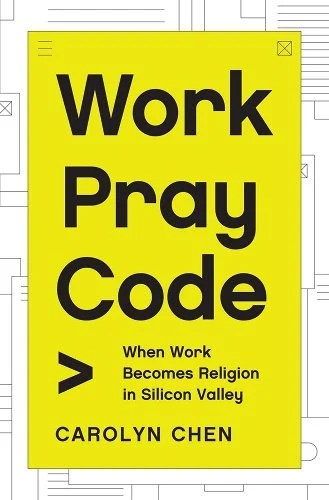
Book Note: Carolyn Chen’s “Work Pray Code”

Carolyn Chen, Work Pray Code: When Work Becomes Religion in the Silicon Valley (Princeton University Press, 2022).

(Amazon; Bookshop)

In Work Pray Code: When Work Becomes Religion in the Silicon Valley, Carolyn Chen asks us (p. 196), “What happens to society when its members worship work?” Then she responds, “Silicon Valley offers us an answer.” The answer is, on the one hand, enlightening, and on the other hand, terrifying. It’s enlightening because it provides us with much-needed insight into the spirituality of the so-called “Nones” (i.e. those who answer the question “With what religion do you affiliate?” with the answer “none”). When people hear “Nones” they may think of people with a religious void, or people who claim to be “spiritual-but-not-religious” (which is a claim founded on a misplaced concreteness regarding the word “religion”). But few “Nones” are religiously apathetic; they place the energies that others may devote to going to a church, synagogue, mosque, temple, etc., to something else but with similar vigor and intent.

While Chen doesn’t provide a working definition of “religion” until Appendix A, her implied definition is clear and aligns with her stated one in the appendix. In short, Chen admits (p. 213), “To find ‘religion’ in Silicon Valley, I realized that I’d have to reexamine my assumptions about what is ‘secular’ and what is ‘religious’.” To do this, she says that there “are two ways of studying religion empirically in a secular age” which she claims are through the clearly “religious” “religious traditions such as Hinduism, Buddhism, Christianity, Islam, and so on” which doesn’t work well for finding religion in the Silicon Valley, and through the less clear idea of “the sacred” which are “the institutions, ideas, practices, spaces and things a community sets aside as special and worthy of worship. Something is sacred because of the power it has over the members of the community.”

This reminds me a bit of Paul Tillich’s definition of “religion” in Theology of Culture (pp. 7-8), “Religion, in the most basic sense of the word, is ultimate concern. And ultimate concern is manifest in all creative functions of the human spirit.” For a Christian, ultimate concern may be a relationship with their god through the person of Jesus resulting in the award of eternal life, and for a Buddhist, ultimate concern may be to reach nirvana, extinguishing the pain of suffering and dissatisfaction. For a Google employee, ultimate concern may be the creativity inherit in their job and the mission of the corporation of which they’re a part.

And this is where it’s terrifying. We should use the word “cult” cautiously because as we know it’s a pejorative that’s often used to dismiss or demonize a religious movement that seems fringe or unfamiliar. As it’s said, “cult plus time equals religion”. Most religious movements are seen as fringe and unfamiliar, dismissed and demonized, in their earlier state but come to receive some level of “respectability” over time. But I do think that when most of us use the word “cult” casually, we’re expressing discomfort not only with the difference we’re observing but the difference plus the level of demand. We’re used to Catholic priests and Buddhist bhikkus giving their lives but outside of these very old, well-established institutions, when a religious movement begins to demand all of someone’s life, especially when it results in that person becoming divorced from the world outside of their religious community, popular discourse refers to this level of control as “cultish” or “cult-like” and the group/community/organization as a “cult”

As you read Chen’s account of how much tech employees pour of their lives into their place of work, and how much it shuts them off from the outside world, you’ll begin to understand why some people see the religious devotion of Silicon Valley workers to their companies as, at least, “cult-like”.

In the Introduction, “How Work is Replacing Religion”, and Chapter 1: “Losing My Religion…and Finding It at Work”, the reader comes to see how and why work has begun to fill the hole where religion used to reside in the hearts of many people. In Chapter 2: “Corporate Maternalism: Nurturing Body and Soul” and Chapter 3: “Managing Souls: The Spiritual Cultivation of Human Capital” we receive insight into how the tech industry sees their employees, in a competitive “knowledge economy”, as investments. They can’t burn out their workers when these are some of the best and brightest minds coming from the top universities and colleges, so they must invest in them, and keep them healthy and happy. Pardon the analogy but it’s like this: you won’t get as much from a cow if you work it to death, so for as much extraction as you may require, there better be an investment. Similarly, free snacks and drinks, yoga lessons, on-site gyms, child care, etc., help corporations keep their employees happy and satisfied, and in return, with every need met on location, it allows for the employee to put in more hours for the corporation.

Now, if this seems dehumanizing, remember what the introduction and first chapter establish: work has become one of the ultimate forms of fulfillment in our society. And as I read these sections, I was reminded of something I’ve seen stated by people who survived the tragedies of The Peoples’ Temple, the Branch Davidians of Waco, and Heaven’s Gate: those were some of the most excited, fulfilling, best days of their lives, even if it all came crashing down on them. And many survivors of these movements, while recognizing something went wrong, never could get the same high as when they were on a mission to save the world. Silicon Valley is full of companies that encourage their workers to see themselves as world-changers, so 12-16 hour days, 6 days a week, isn’t a sacrifice.

Chapter 4: “The Dharma according to Google” and Chapter 5: “Killing the Buddha” examine what happens when workplaces import religious practices while often stripping them of their religious affiliations. This process is what Chen calls, “the secular diffusion of religion” (p. 16). We’ve seen it: yoga has hardly anything to do with Hindu thought and practice in the minds of most Americans who practice it; mindfulness has little to do with the Buddhist meditative practices from which it derives. So, what happens when a Zen teacher is contracted by a corporation to come and teach mindfulness while leaving their Buddhism at the door? Cognitive dissonance is often what happens. For many “spiritual coaches” in the Bay Area, there’s the pragmatics of needing to afford to live in one of the most expensive places in the world, so if they have to offer “Diet Buddhism” so be it. For others, there’s a sense that some Buddhism, even if unnamed, does more for the world than no Buddhism. And for others, it was too much, and some tech workers, meditation teachers, etc., decided that their religion was being corrupted by its marriage to big tech and then decided to choose their religion over big tech.

Chapter 5: “Killing the Buddha” may be worth the price of the book (though, you benefit from the rest of the book when it comes to understanding this)! Chen takes from the Zen saying, “If you meet the Buddha, kill him” (which, while interpreted diversely, has come to mean for some that you should kill the “religious trapping in the practice of Buddhist meditation” [p. 155]), and shows that this can be very problematic when we observe how it’s applied. Chen discusses five types of Buddism that emerge when corporations want the perks of Buddhist practice without all the things that may be considered “religious” sounding and looking. Those types of Buddhism are “Hidden Buddhism” as in the practices are Buddhist, but out of fear of violating Title VII, must be done without reference to their origins. Whitened Buddhism is Buddhism not only without its religiosity but “It erases the ‘ethnic’ and ‘religious’ Buddhism of Asians and Asian Americans in favor of the thinking and experience of White Westerners.” (p. 162) Scientific Buddhism is when CEOs or HR can be sold the benefits of Buddhism by appealing to the scientific studies that may indicate that meditation/mindfulness has certain psychological and physical benefits to it that will benefit the company (remember the themes of chapters 2 and 3). Bottom-Line Buddhism is directly connected to Scientific Buddhism: if workers are serene, peaceful, and free from anxiety, this will bring down lost hours, health-care costs, etc. So, Bottom-Line Buddhism is sold to corporations on the promise that it’ll increase productivity, reduce costs, and ultimately result in profit. Finally, On-the-Go Buddhism is just as it sounds: a religion that may ask you to spend time being in meditation is squeezed into a fast-food version of itself that’s suitable for busy tech workers.

The Conclusion: “Techtopia: Privatized Wholeness and Public Brokenness” examines the fallout of this sort of work-as-religion worldview, ranging from work “colonizing” the time of its employees to the displacement and economic turmoil the tech industry has caused in the Bay Area. Now, as I’ve spent much more time on the negative impact of work-as-religion, I want to be clear that this book isn’t a hit job. It’s quite fair to tech industry at many points. Chen embedded herself in that world for five years, so she got to know the people, the companies, and their culture. And as a former resident of San Francisco myself, I can resonate with the high of Bay Area life. It’s not just the West Coast of the United States but it often feels like you’re on the edge of the future, and I didn’t even work any jobs even remotely related to tech. So, while we may be rightly concerned with people giving their everything to work so that they’re no longer part of a church, or a PTA or HOA, or local politics, etc., let’s remember that tech jobs do provide purpose and mission, and as many religious institutions have failed to be able to show people their “purpose-driven life” (to borrow from Rick Warren’s 2000s approach to American Christianity), the tech industry has been able to do it. As religion becomes less relevant in the lives of many Americans, new forms of “ultimate concern” are created and offered to seekers everywhere.

Book Note: James Baldwin’s “Notes of a Native Son”

James Baldwin, Notes of a Native Son (reprt. 2012; Boston: Beacon Press, 1955). (Amazon; Bookshop)

I didn’t intend to finish this book during the weekend when we celebrate the birthday of the Rev. Dr. Martin Luther King, Jr. Actually, I started reading it a few months ago and I thought I’d finish it during the winter break but as I’m prone to do, I got distracted when a new wave of books arrived in my mailbox. But I made my way back to it and now I’ve read it.

I think one of the things white Americans need to know is this: MLK isn’t the only Black American voice with which we should be familiar. Also, the parts of MLK’s legacy with which most of us are familiar are often sanitized for us. But if we really care to hear the voice of our Black neighbor, we need to read more of King’s corpus, and we need to hear voices other than those of King.

Whenever I read a book by a Black author I’m hesitant to say much because (1) it can come across as virtue signaling and (2) it places me back in the central role as a speaker rather than a listener. So, I’ll say little. Instead, I’ll say: go read this book if you want to hear the thoughts of one of America’s legendary and insightful Black authors. What I will say is more of a sharing; a sharing of a few of the statements that really hit me between the eyes:

  1. In the “Preface to the 1984 Edition,” Baldwin writes of white Americans that when our legends are attacked, “as is happening now—all over the globe which has never been and never will be White—my countrymen become childishly vindictive and unutterably dangerous.” (p. xxii). If we’ve seen anything over the past half-decade, it’s this. Threatened by pluralism, white Americans have become scary. Baldwin reminds us a paragraph later: “The people who think of themselves as White have the choice of becoming human or irrelevant.”
  2. An important experience I had while reading this book is recognizing how many Black Americans feel white Americans see them but also hearing how many Black Americans feel about white America. (Note: I’m torn between capitalizing “White” since in a sense, to keep it lower-case seems to universalize whiteness when whites are just one demographic among many in the United States while simultaneously sensing that one of the things white supremacy has done to white people is prevent us from actually creating a constructive culture of which we can be proud because much of our identity-making has been a project that attempt to lift ourselves up at the expense of people of color, making me wonder is the lower-case, denoting a lack of unified culture built around any real solidarity, is more appropriate. I don’t know.) Baldwin speaks of himself as a “kind of bastard of the West; when I followed the line of my past I did not find myself in Europe but in Africa.” (p. 6 from “Autobiographical Notes”) He comments that much of what is celebrating in this country, “Shakespeare, Bach, Rembrandt, to the strong of Paris, the cathedral at Chartes, and to the Empire State Building” are “not really my creations; they did not contain my history”. (pp. 6-7) Baldwin observes that to be Black in America means that one must “hide from himself as the price of his public progress”. (p. 9) And as he writes in “Many Thousands Gone,” for the Black American, “the past was taken from him whether he would or no,” (p. 30) as he is “adopts the vestures of his adopted land” (p. 30).
  3. People like me need to realize that our whiteness—not pigmentation but the cultural weight of whiteness that we white people have created—can become threatening even if that’s not our intent because so many people who look like us have used their whiteness to dehumanize our Black neighbor. In the essay, “Notes on a Native Son,” Baldwin remembers a time when he basically zoned out when he was refused service by a white female waitress and that this dehumanizing act “made me colder and more murderous than ever” (p. 98) Even as the woman fearfully and hesitantly enforced segregation, her feelings about her participation in this act were secondary to what the act was doing to Baldwin. Baldwin didn’t do anything he ended up regretting but what he felt arise in him scared him. On several other occassions, he comments on these feelings. For example, in “Stranger in the Village,” he says, “…since white men represent in the black man’s world so heavy a weight, white men have for black men a reality which is far from being reciprocal; and hence all black men have toward all white men an attitude which is designed, really, either to rob the white man of the jewel of his naïveté, or else to make it cost him dear.” In the next sentence (p. 170), he states, “The black man insists, by whatever means he finds at his disposal, that the white mean cease to regard him as an exotic rarity and recognize him as a human being.”
  4. Baldwin’s comments in his “Autobiographical Notes” (p. 9), “I love America more than any other country in the world, and, exactly for this reason, I insist on the right to criticize her perpetually.” This was made evident in narrative form in his essays on his time in Paris, where for all the perks of experiencing French culture, he still felt away from home. Many white Americans have the attitude that “if you don’t like it, leave,” which is silly, at best. True love doesn’t mean lying to yourself or cheerleading everything that something or someone you love does. You can love a child or a parent and rebuke them. In fact, you must if you truly love them. We white Americans need to learn that the anger we hear from some Black voices is often more disappointment than anything. Black Americans love this country as much as white Americans do, maybe more when you look at how many white Americans would happily cast aside democracy in order to establish a ethno-state or a theocracy.

I said too much. Read the book.

Book Note: David Janzen’s “Trauma and the Failure of History”

David Janzen, Trauma and the Failure of History: Kings, Lamentations, and the Destructions of Jerusalem (Semeia 94; Atlanta: SBL Press, 2019). (Amazon; Bookshop)

If much of the Jewish Tanakh/Christian Old Testament can be understood as apologetic for the god of Judah after the events of the Babylonian Exile, then what catches my attention are the voices of dissent. For example, the Book of Proverbs with its emphasis on wisdom can be interpreted rigidly, almost mathematically, to read that those who do well in life must be the ones who lived by the guidance of divine wisdom while those who struggle must be the fools. Then comes along the author of the Book of Ecclesiastes and overthrows that whole ideology by pointing out that it’s too simple/simplistic.

The Deuteronomistic impulse is to justify the divinity while blaming the humans for what happened during the Exile; it’s to warn how the people shouldn’t behave if they want to avoid a repeat. That impulse is found in the Book of Kings where the blame for the Exile sits on the shoulders of the people—and as Janzen observes, specifically the people, not the royalty of the House of David. But the Book of Lamentations, which sometimes tries to fall in line and echo the rationale found in the Kings, but often simply can’t, is evidence of a dissenting voice.

In Trauma and the Failure of History, Janzen presents “history” as a narrative about past events that attempts to explain them and provide a true presentation and interpretation. The Book of Kings is such a work. It narrates past events leading to the Exile as a way of explaining “how did we get here”.

But trauma can’t make simple sense of what’s been experienced. There’s no metanarrative that comforts. Trauma doesn’t explain the past because in a sense the past is present, the effects linger. For Janzen, this is what we find in the Book of Lamentations. This texts fails to explain what happened to Jerusalem because it simply grieves what happened to Jerusalem.

I highly recommend this book, especially for those who are interested in the internal conversation found in the Hebrew Bible around topics related to theodicy. It reminds me a little of a couple other books I’ve mentioned on this blog: